Showing posts with label elizabeth jia. Show all posts

Sunday, December 5, 2010

Getting Help: Veterans With PTSD Get Simplified Process For Benefits

by: Elizabeth Jia

The bullet pierced through the Marine’s left ear and tunneled out of his mouth.

In the midst of the war in Iraq, Justin Constantine suffered violent head trauma. It was 2006. Constantine underwent massive facial reconstruction in Germany. His hospital pictures showed a severely swollen head. His face, disfigured. Dahlia Hamza, his girlfriend at the time, halted her graduate studies and flew to his bedside.

The Civil Affairs Team Leader routinely took charge. Now he would find the internal motivation to push through recovery. Constantine said the support from Dahlia, now his wife, sped up the healing of his physical wounds. He came home to the States and was honored with a Purple Heart medal.

He looked different on the outside, but that was temporary. Yet as his flesh and bone were mended, stitched or replaced, another wound emerged. This time the damage would be invisible. But it plagued the veteran as if he had sustained another traumatic injury. He did.

His symptoms: road rage, extreme irritability and insomnia. When he could sleep, he suffered nightmares. Dahlia would have to wake her husband up to rescue him from the dreams. When he woke up, he could not remember what happened in his sleep.

When he reached a positive recovery stage, Constantine applied for health benefits through the Department of Veterans Affairs (VA) in 2007. He collected copious medical records and wrote a detailed account of how he sustained his head injury. The VA diagnosed him with combat-related Post Traumatic Stress Disorder or PTSD.

That diagnosis took one year from start to final determination.

Meanwhile, the PTSD symptoms persisted. Constantine had to wait before the VA could authorize any treatment for this invisible wound. He did not have access to medication or counseling for his irritability or nightmares. Without the proper diagnosis, Constantine would not begin connecting with existent or emerging PTSD resources.

On September 2, 2010, Constantine sat inside a Starbucks near Pentagon City Mall in Virginia. He is physically, if not emotionally, far away from the war zone. His crooked jaw supported a mouth revealing a row of lower teeth. The former Judge Advocate for the Marine Corps talked with gusto about applying for PTSD-related benefits.

“So the process was complicated. I am lucky that I am a lawyer by trade…I’m used to writing things, and so it was a little easier for me I guess than for others to prepare a document,” said Constantine.

At the time, the veteran must give an example of a specific combat stressor or event. Only then would VA adjudicators approve that the PTSD developed from combat experience. Constantine said his face and head injuries irrefutably showed his PTSD was linked to experience in a war zone.

He worried about friends on the battlefield. He imagined the application process would be harder. For example, a Corpsman would have witnessed Constantine’s ghastly head injury. But he may have faced a tough time proving he had PTSD because he did not have physical scars to show for the incident.

In those cases the application process could drag on much longer. It was nearly a decade for a former Vietnam War platoon leader who wished to remain anonymous. He said it took him eight years from “February 7, 2000 to February 27, 2008 for the VA to recognize and make a determination on the PTSD.” He said his meticulous documentation and appeals to the VA got him the 70% benefits rating for his PTSD diagnosis.

Access to these benefits averted a potential tragedy. He said at one point, he was not thinking if he should kill himself, but how he was going to do it. But having access to a VA counselor during his darkest times meant that he did overcome.

“I’m smart enough and determined enough to make the system work. My question is, ‘What happens to some Staff Sergeant, or Sergeant or Corporal who gets the kind of treatment I did?’ That person, she doesn’t know where to go or what to do,” he said.

The results could be tragic as shown in the 2010 Veteran’s Day HBO Special on PTSD’s silent but deadly effects. Army veteran Noah Pierce placed his dog tag in between a gun and his head. He pulled the trigger. Noah’s mother showed the punched hole in her son’s dog tag. She said the military forgot to “untrain” her son after shaping him into a killing machine.

Pierce did not get diagnosed for PTSD. Armor and ammunition may help save lives. But survivors with combat experience cannot be shielded from mental trauma, according to former Army Captain Tom Tarantino, the Legislative Associate for Iraq and Afghanistan Veterans of America. Meanwhile, reports have shown one in eight veterans experience PTSD.

Until this year the VA’s procedure demanded that the Veteran bear the burden of demonstrating a “specific combat stressor or event” proving to VA adjudicators that PTSD stemmed from combat.

The VA took action to address the application hurdles. On July 13, 2010, the VA simplified the application process for access to medical benefits from combat-related PTSD. The Veteran no longer needed to identify a specific incident that proved his or her illness resulted from warfare.

As VA Secretary,[former Army Chief of Staff] General Eric Shinseki explained, “No longer focusing on documenting a stressor event, our new process streamlines the delivery of medical care and benefits to Veterans suffering verifiable PTSD resulting from combat.”

The attention on veterans’ benefits has come at a time when the VA may be facing an influx of men and women returning from service in Iraq and Afghanistan. To anticipate the hurdles veterans may face, Senate lawmakers in the 111th Congress introduced a bill (H.R.952 IH) to adjust the qualifications for determining combat-related PTSD for Veterans seeking service connection at the VA.

The bill did not need to move further. The VA took the initiative and made its own decision to ease the Veteran’s burden of proof.

“This is not just about Iraq and Afghanistan. It is a generational issue—and we aim to get it right for every generation that has gone to war for this country, and all future generations,” Secretary General Shinseki said.

He also highlighted the VA’s increased mental health budget of $379 million in 2010. The year before, the VA devoted $4.5 billion for mental health programs and launched a workforce surge to bring staffing to over 20,000.

The VA’s changes have sped up the application process for Marine veteran Brian Drayton. He said he got his PTSD diagnosis within five months after starting the process on May 12, 2010. Drayton’s access to counseling and anxiety medication helped him get back into the civilian workforce as an electrician. He said he probably would not be working if he did not take his pills.

The well-traveled veteran served tours in Japan, Korea, Bahrain, Kuwait and Iraq. Living outside the military proved a harder journey. The former Combat Engineer had completed service July, 2009. He said he experienced an unreasonably angry outburst after a friend cancelled a meeting.

He said a private counselor in Waco, Texas diagnosed him with PTSD. When he went through the VA process, he had to be interviewed by the VA adjudicator who would make a separate PTSD diagnosis.

Some like the anonymous Vietnam Veteran thought the PTSD re-evaluation as inefficient. However, Drayton said the independent diagnosis served as leverage for his case to the VA adjudicator. He also supported curbing fraud.

“I’ve ran into a few people that have been lying about their service in Iraq and Afghanistan and what happened to ’em. There are some Veterans out there, some people out there that are gonna try and abuse the system,” he said.

Moreover, not every independent counselor is trained in diagnosing combat PTSD, according to Dr. Antoinette Zeiss, Ph.D., the Acting Deputy Chief Patient Care Services Officer for Mental Health at the VA. Therefore, the VA needs its own set of adjudicators, she said.

Drayton suggested veterans go through the VA while memories remain fresh. Also, the Veteran may not have the luxury of time to devote to the VA process later with family and job duties. He said although he may have felt uncomfortable with the VA’s scrutiny of his problems, the process was worth it.

The VA has sought to give care to Veterans who fit the criteria for PTSD, Secretary General Shinseki said. He emphasized the difference between PTS and PTSD as he spoke to student Veterans adjusting to civilian life. “[T]he transition can be tough because some—perhaps more than some of you—are ‘carrying baggage.’ That’s a euphemism for P-T-S—post traumatic stress.”

Those who return from the combat zone cannot deny having some form of traumatic mental stress, said Dr. Susan Mareck, Ph.D., Clinical Psychologist at the VA. After proper diagnosis, veterans could be steered to ways of coping on the most basic level like maintaining a routine, a healthy lifestyle, and strong bonds with family.

Veterans should be proactive in managing their combat-related stresses so the illness does not become more severe, according to Allen Gill, Special Assistant to Secretary General Shinseki.

“Many, if not most, Veterans who have been in combat situations or settings experience PTS to some degree, but would not meet the full diagnostic criteria for PTSD,” Gill wrote in an e-mail.

“Even PTS may disrupt work, lives, relationships, and readjustment to civilian life, and that's why VA encourages eligible Veterans with PTS to enroll for VA care and seek health care services that may improve their lives and prevent development of PTSD,” Gill continued.

The shame and stigma associated with PTSD has pushed men and women away from seeking help. Instead, they may resort to masking the problem with unhealthy habits like alcoholism, belligerence and other self-destructive behaviors.

David Sharpe, an Air Force veteran, said he would punch walls and kick his refrigerator when he was alone. When he was out with friends, he wanted to fight strangers.

Sharpe’s family and friends suggested getting a pit bull puppy. Soon, Cheyenne came into his life. Sharpe said the dog saved his life as he struggled with depression, PTSD and a suicide attempt. Cheyenne would “lick the tears off my face,” he said. Then he would open up and talk to his dog. Eight years after his service, Sharpe started the VA process in 2010. He said he got benefits from the VA for his PTSD in four months.

The unconditional love from Cheyenne sparked an idea. In 2009 Sharpe launched P2V (Pets2Vets), an all-volunteer non-profit, offering servicemen a means to adopt a pet from a local animal shelter. P2V gives veterans a way to “feel completely at ease,” with an adopted furry friend.

Through P2V Raymond Crook, an Army veteran from the Cold War, found joyful companionship with a dog named Meyers. He had been an executive chef after leaving the military. Crook suffered from PTSD for over ten years, losing jobs, straining relationships, before reaching the brink of suicide. He almost turned the knife on himself.

Crook finally went to the VA in 2009 and got benefit access after one year. He said he wished he had reached out sooner, so he could have saved himself “ten years of hell.”

The VA’s Dr. Zeiss acknowledged that PTSD may not be completely cured, but with proper channels, the illness can be managed.

“Awesome,” Crook said of the changes in the system. He said he wished the VA would also offer a thorough debriefing program for veterans as soon as service ends to ease the mental transition from war.

“I want to assure you that VA is there for you,” said Secretary General Shinseki. He outlined the President’s 16% increase to the VA 2010 budget as the largest single-year jump in 30 years. As the VA operates on $114 billion, President Obama has proposed a budget of $125 billion for 2011.

“[The budget] will give us needed firepower to increase your access to our benefits and healthcare services, and to end the disability claims backlog,” said Secretary General Shinseki as he stood in front of student veterans at Georgetown University’s Student Veterans of America awards dinner, Oct. 2, 2010.

James Day, a recent Marine veteran, sat at one table listening to the speech. He is a husband, father to a young child, and freshman at CalState Long Beach. Several guests stopped to ask for a photograph with him. He would graciously agree to each request. He walked with cane in hand to pose for the photograph.

“I can’t complain. You always hear those horror stories, generally for years by, but I tell ya’, I love VA healthcare. It’s taking care of me.”

Day worked with chemical, biological, radiological, and nuclear weapons. While eating and chatting with veterans, he smiled and joked at the table about wanting to find a good diner like the ones in the South. A casual observer would not catch that he suffered from hyper vigilance and other PTSD issues.

“I do have family and I didn’t like who I was like that, and I most certainly didn’t want them to have to deal with me like that,” he said of his motivation for going through the VA process.

He got access to full VA medical benefits. After leaving four years of service on May 5, 2010, and started his VA benefits process on May 9, 2010. Day said other veterans with PTSD should connect with the VA:

“We all served together, we’re brothers and sisters. Really, there shouldn’t be a reason why you shouldn’t go and get help. I mean if you’re pinned down a firefight, you wouldn’t try to just take them all on your own, would you? You’d call for help. There’s no reason why right now just ‘cause you can’t see the enemy, doesn’t mean that your brothers and sisters can’t help you fight it.”

Besides the VA resources, family members have played a key role in the ongoing recovery of the veteran. Dahlia Constantine said being a caretaker without having access to outside resources put significant stress on her own health.

She said the VA had made a step in the right direction with modifying the PTSD guidelines.

“I’m sad that it took so long for it to happen. But I think as a society, we still have a lot of shame and taboos surrounding issues of mental health. Even though the brain and heart are a part of the body, and what they feel is just like a leg or an arm.”

Dahlia interpreted the change as a positive sign of a shift in military culture.

“The military environment is much more macho than the average American society and talking about your problems or your feelings isn’t supported…I’m sure it’s gonna take a couple of years for things to go a lot more seamlessly and smoothly but at least the policy, the message going out to the public now, is that people should seek help.”

See Justin Constantine and other veterans in this video.

Friday, October 2, 2009

My New DO!


Ok, it's been awhile since my last post. In a Nutshell: Our class is done and I got an A in it! Woohoo!


I also went to Shanghai, China for ten days. It was for a sad reason, my grandpa passed away. But he lived a really fulfilling life and for that, I am so grateful for all the times I've gotten to talk with him on the phone and spend that quality time with him in Dec. 08.


The last conversation we had was on the phone before I left for a business trip to Boston. He sounded really happy for all the things going on in my life. We ended the call on such a high note!


He left his memoir...a body of work I sorta pushed for him to start. I want to translate it.


Anyways....What do you think about my new do?


Thursday, August 13, 2009

AAJA Convention 2009


I attended AAJA 2009 Convention in Boston. This was my first time at the Asian American Journalism Convention.


I recruited, held a workshop on how to build a website using online tools, and sang and danced!
The economy may be bleak but it didn't stop convention-goers from partying it up!


Good times!


Friday, July 10, 2009

Web Redesign: Inspector General of the Interior


Here are seven questions and answers to redesigning the website for the Inspector General of the U.S. Dept of the Interior.

It needs a face lift...badly.

1. Who is our target audience (hint: Don't try to be all things to all people)


1st - Media and Congress are the main focus.

2nd- Still, the general public, taxpayers are the ultimate reach. By pushing the newly designed IG website to the media and Congress, it is hoped that the work accomplished by the IG of the Interior will be reported more often.

2. What is the competitive landscape? (hint: Sites that do it well)

GAO does it better. Their IG webpage is under their main homepage. They have well- defined lists of recent reports. Also, GAO has presence on Twitter. There are also links designated for Congress and Media.

3. How do we differentiate ourselves? (hint: Secret sauce)

The mission of the redesign is to showcase the office's reports and investigations within a multimedia framework.

Pictures and video material will be attached to the reports. Katy has indicated that the office already uses photos and video in its investigations. However, these materials are not being put on the web at the moment. We will put these element on the website.

The website will be more interactive with a map of the US highlighting "high profile" investigations by the office. There will be a small map icon on the main front page that would lead to a full page featuring the interactive map.

4. How do we create our site? (hint: Staff and schedule)

Designate two core web editors who write brief summaries of the reports. They will also populate and organize the website.

Public Relations person will Twitter information about the latest reports.

IT person will execute the act of putting new items on the website.

Katy has said there is an independent contractor already hired to redesign the site. This contractor will create the web template that others can implement.

5. How do we get our content? (hint: Pre-built, manual, automatic, updated)

Content will be collected from the office's investigations, audits, evaluations, inspections and assessments.

Many of these, already conducted by IG employees, have video and still pictures as part of their reports. These investigators already are use to doing two versions of their reports – a "redacted" version and one for internal files.

The website will use the "redacted" version of the reports.

6. How do we market our site? (hint: Spread the word)

A. Get a list of media outlets and have PR person send e-mail alerts on the latest IG office reports. Send out weekly press releases highlighting any visuals.

The PR person will send an email with two web links:
1. the web link related to the specific topic relevant to the media contact.
2. the main website address

B. Twitter, Facebook, YouTube will be utilized in a similar fashion to the GAO office.

C. Katy says there is an existing campaign marketing the IG Interior's complaint hotline. The campaign will be updated to include the website address.

D. Link our website to www.recovery.gov. And include our website on www.recovery.gov's site.

E. Change the website address to InteriorIG.gov – easier to market than the current: http://www.doioig.com/ – (dept of interior office of inspector general).

7. How do we sustain the site? (hint: Show me the $$$)

Funds would be doled out via Federal appropriations and employees already on the payroll. President Obama has said he wants to make the federal government more transparent and interactive on the web. Revamping this website would be at par with the President's mission.

Sunday, July 5, 2009

What I've Learned About Hatching The Idea


So after listening to Cynthia Farrar, creator of PurpleStates.tv, I have gathered some conclusions about the elevator pitch.

I think the biggest thing I've taken away from the presentation is that you have to gather people who can generate momentum, excitement and the know-how to get the idea off the ground in a specific window of time. I think generally, that window of time is rather SMALL. So you have to work quickly.

I think if you let the idea brew for too long, there will be ample amount of people who would have the time to bring up criticism and drawbacks related to the idea. This will significantly impact the idea's prospects of becoming a reality. Don't let them knock down the idea even if it IS a "straw man" at this beginning stage.

So, I take to heart that with any idea, one must find supporters and those who "get it" as soon as possible. These people's belief in the idea will help keep discouragement at bay and be a motivator for the creator.

Oh....and here is my "Spoons" elevator pitch:

"Spoons" is a site offering fun ways to cook simple meals designed for the novice cook. Cooks at the beginner's level are often intimidated and don't know where to start honing their skills. This website will offer simple how-to videos and easy recipes. Moreover, the website will provide a meeting place for all culinary lovers. People will build a network of their own culinary friends to share recipes, advice and pictures about their experiences in the kitchen.

What makes the website stand out is that all the recipes incorporate the use of a set of color-coded measuring utensils. These utensils may be ordered and given out for free in the first year of of the website's launch. Kitchen ware companies may sponsor these spoons.

There's a saying that to understand another person, one must "break bread" with him or her. Well, with "Spoons," each person lands a spot at the virtual dinner table.


Thursday, June 25, 2009

Fine-tuning Spoons: Elizabeth Jia's Idea


Cooking for Rookies

QUESTIONS and ANSWERS:

1. How do you connect the three distinct parts? Videos/spoons/social networking?

The three parts would be integrated. There would be a video section on the website. The social-networking component is integrated into the entire website. Users log into the site in order to friend others, download recipes, and share their culinary experiences.

The spoons are the TANGIBLE aspect of the entire project. The spoons should be ordered/purchased via the website OR gotten through a promotional event (festival, weekend event..etc.)


2.Instructional cooking videos are hard to pull off. Especially for user generated content because of lighting etc.

The videos would be produced by the website staff AND any willing sponsors.

Producing all those spoons will be difficult-- who will pay for them? Will they be donated? Shipping and hand?

The spoons will be designed and produced by a utensil/kitchen ware company. Shipping and handling would be handled via the start-up funds of the website. Also, the promote the website, the initial stages of handing out the spoons will rely heavily on local events where "street teams" would be deployed to hand out the spoons.

Will people want to give their addresses out to you so you can send them the spoons?

People may feel safe if the website uses a safe/secure site like Paypal.

3. Ads on the videos would bring in money to pay for spoons and maybe sell logos on the spoons to companies to pay for the spoons. If users sign up to get spoons try to get them to opt in for email to try to sell email lists or solicit money that way or get advertisers or sell ads on emails that way.

Yes, the ads and user generated information would be good data for advertisers. So, Spoons would be able to provide this information to third-party advertisers.

--------------------------------------------------------------------------

This is the one-stop-shop for those in search of a multimedia experience that will foster their culinary skills.

The main target audience is someone who wants to learn how to make a simple, tasty dish while eliminating the hassle of measuring things out. The focus is ENTIRELY on making this FUN.

Users of the site can order ONE FREE SET of measuring spoons and cups. These utensils are created with the website in mind. Each spoon will be a different color. The cups will also be designed with color-coded lines.

So the recipes on the site would read: "Add the thyme using the RED spoon. Fill water to the red line on the cup." Additional orders will cost a pre-determined amount.

Owners of this website can invite kitchen utensil companies to sponsor the design of these utensils.

The Multimedia Elements
With these measuring utensils, the audience can follow the easy recipes step-by-step. They can also WATCH video clips of sample dishes being made. There will be user-generated photos of food in a photo gallery. There will also be a news section on food-related/health articles, tip-of-the-day, and advice.

To PROMOTE the website, there will be multiple outings to area festivals, events, etc. to give away free sets of measuring spoons and cups. They are encouraged to visit the website and start cooking using the spoons and cups. These utensils will also have the website logo on them.

The cooking site will slowly expand to include different cuisines: American, Chinese, Italian, Greek, etc etc.

The site will also have a social-networking component. You can "friend" rookies, cooks, chefs, kitchen helper and any other titles that the public can choose to describe their level of culinary skills.


Humanhood.com Vs. Determined2.com

These two social-networking sites focus on helping the public reach personal goals. But, one site clearly dominates over the other in terms of popularity and appeal.

Humanhood.com's homepage shows a timer counting up to the time until it doles out the next batch of invites to the public. It also asks for the new user to enter an email address.


The only reason I know of Humanhood.com is through news articles and the public's comments. But in order to really find out what Humanhood.com is all about, you HAVE to become a member. This exclusivity may deter some users. But given the buzz around this site, it actually works to the site's advantage.


After I entered my e-mail, a "thank you" message appears and says I have to check for an invite on May 28th. I am eager to get the invite through my email and start exploring the site.


On the other hand, Determined2.com also promises to help you to stop procrastinating and start accomplishing. However, before I sign up, I am exploring the pages and seeing that the featured new members of the site have "no goals" labeled on their entries. This clearly isn't appealing to me.

I don't want to be part of a network about accomplishing goals and then seeing that its members have no goals and have not accomplished much.


Humanhood.com
clearly
wins.

The "In" Crowd

Forget "social-networking"...let's call it what it is: Being on the "in." Every single community-building feature on the website hopes that the public will jump in.

For example, my station's website, wusa9.com, allows readers to comment on stories only if they have registered and logged onto the site. Without signing up with wusa9.com, you cannot comment on stories or blogs.


And as a member of wusa9.com, you are able to "friend" others, message others, participate in forums, upload photos, create your own profile, and create your own blog.

Basically, wusa9.com is not only a news website. It's also a platform for the public to express themselves and in turn, become more invested in the site.

I often respond back to the comments on my blog. It definitely helps to keep the discussions alive on a blog entry


Wednesday, June 10, 2009

So Good, It's Bad

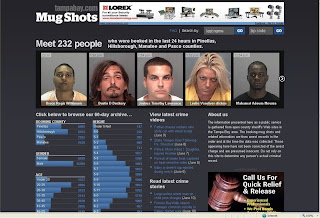
This multimedia effort is so successful, and yet it's so ethically questionable. The St. Petersburg Times' online staff of Tampabay.com, created a website with a computer program that searches and compiles the mugshots of everyone arrested and booked in the Tampa Bay area's four counties: Pinellas, Hillsborough, Manatee and Pasco.


The completely automated computer program searches the database of each county's sheriff's website and puts up the profiles of those arrested in the last 24 hours. The data is also broken down by gender, height, weight, age, and eye color. Crime articles and videos also populate the site.

The site says it is a public service website that helps those to search and "meet" those arrested by last name and zip code.

The Poynter Institute held an online chat with the programmer behind this site, Matt Waite. They discussed some big ethical concerns. (Scroll down to the online chat transcript.)

In the chat, the public had a concern with Google's ability to pick up these mug shots. Waite insisted that they took pains to keep Google away from this site. And also, after 60 days, the photos of these individuals would be flushed out from the site. Except, the records of one county goes back to 1995.

From a multimedia standpoint, this website is VERY successful. The individual county sheriff's sites have very old-fashioned, boring looking designs. Also, nothing is streamlined. One county's "arrests inquiry" is the same as another's "who is in jail" section.

Also, I can't help but look at the faces of these people. Waite says that only those files with mugshots get to be placed on the site.

However, from an ethical standpoint, these people are being wrongfully associated with crime in these four counties. Just because they are arrested, it does not mean they are guilty. The site states this fact in its "about us" section. However, I can't help but wonder how many people would look at these mugshots and NOT think: CRIMINAL.

Also, the statistics of gender, age, height create a visual representation: it gives the impression that these statistics are representative of ALL those arrested in the four counties. However, that is false. Some individuals with faulty mugshots or no image are NOT placed on the website.

Waite says in the Poynter chat that this project was spawned from his paper noticing that there was more online traffic on crime stories containing a mugshot.

There's a "Facebook" feel to the website. It's very visually clean and modern. However, to me, it's not a public service. To me, the site feeds on the public's curiosity and facination with the mugshots.